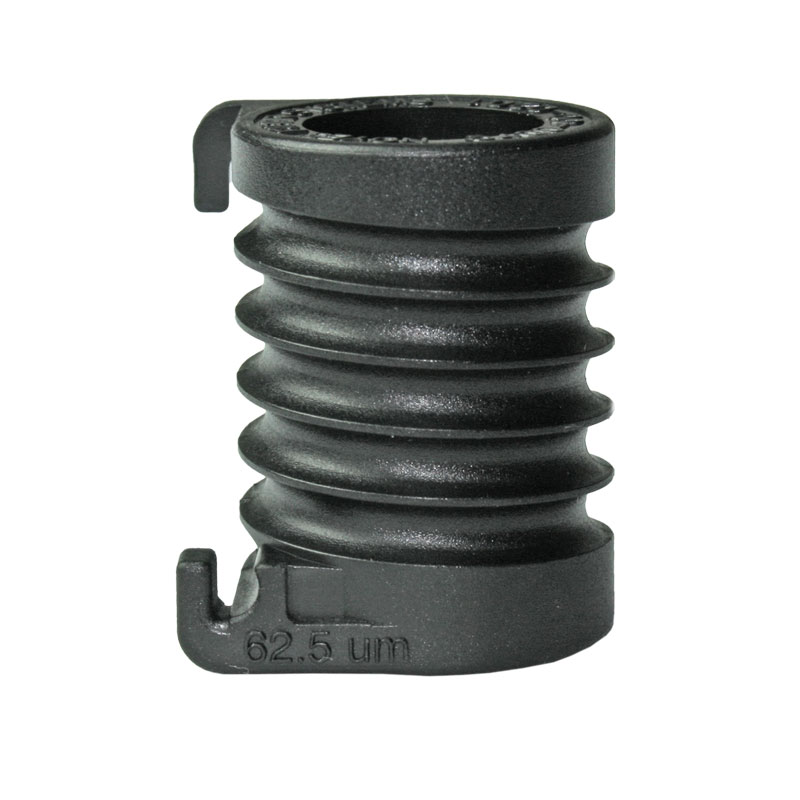
To meet the new multimode light source requirements in TIA/EIA-568-B, AFL offers mandrels for 50 and 62.5 µm test jumpers with 3 mm jackets. Both mandrels have grooves to ensure that jumpers are wrapped exactly five times (as specified by TIA/EIA-568-B) and can be easily attached to test jumpers in seconds without tools or tape.
81379423dda84875a040082e4bec1989
1 Test & Inspection AFLglobal.com | 800.235.3423 Accessories Mandrels ©2020, AFL, all rights reserved. 5400-00-2001 Revision AD 2020-11-04 Specifications are subject to change without notice . For use with 62.5 and 50 μm Multimode Test J umpers with 3 mm J ackets Features • Allows existing 850/1300 nm LED light sources to test 50 and 62.5 μm links • Attaches to 3 mm jumpers in seconds, without tools or tape • May be reused indefinitely Applications • Required by TIA/EIA-568-B to measure attenuation on multimode fiber links • Certification of multimode links for Gigabit and 10 Gigabit Ethernet 62.5 μm 50 μm TIA/EIA-568-B specifies that attenuation (insertion loss) measurements of multimode fiber links, for all applications, must be made using an overfilled light source, such as an LED, with a mandrel-wrap mode filter on the transmit jumper. A key advantage of this specification is that it allows the use of existing overfilled LED light sources to certify both 50 and 62.5 μm fiber links for current and planned high bit rate applications including Gigabit Ethernet and 10 Gigabit Ethernet. To meet the new multimode light source requirements in TIA/EIA-568-B, we offer mandrels for 50 and 62.5 μm test jumpers with 3 mm jackets. Both mandrels have grooves to ensure that jumpers are wrapped exactly five times (as specified by TIA/EIA-568-B) and can be easily attached to test jumpers in seconds without tools or tape. Ordering Information DESCRIPTION AFL NO. Kit with two mandrels: 62.5 and 50 μm fiber 5400-00-0900 Mandrel, 62.5 μm fiber 5400-00-0201 Mandrel, 50 μm fiber 5400-00-0202
2 Test & Inspection AFLglobal.com | 800.235.3423 Accessories Mandrels Transmit jumper Mandrel wrap ST adapter cap Light Source Power Meter 0 dB Transmit jumper Mandrel wrap ST adapter cap 0 dB 0 dB Transmit jumper Mandrel 5 wraps Transmit jumper Mandrel 5 wraps 5 wraps Receive jumper ST adapter Cap ST adapter Transmit jumper Mandrel wrap 0.4 dB Receive jumper Receive jumper ST adapter Cap ST adapter Transmit jumper Mandrel wrap 0.4 dB 0.4 dB Link under test Transmit jumper Mandrel wrap Receive Jumper ST adapter cap ST ST 3.2 dB 3.2 dB 3.2 dB ©2020, AFL, all rights reserved. 5400-00-2001 Revision AD 2020-11-04 Specifications are subject to change without notice . For use with 62.5 and 50 μm Multimode Test Jumpers with 3 mm Jackets 1 Attach Mandrel Wrap the transmit jumper five times around the mandrel and attach it to the output port of the OLS 1 (LED source). Attach the ST adapter cap to the input port of the OPM 5 (optical power meter). Turn both units on and set wavelength to 850 nm. 2 Set Reference (One Jumper Method) Connect the output of the OLS 1 directly to the input (ST adapter cap) of the OPM 5. Then press and hold the Set Ref (set reference) key until the word “HELD” appears. When you release the Set Ref key the OPM 5 should display “0 dB” (+/- 0.05 dB) indicating that the power measured at output of the transmit jumper has been recorded as the reference level for your insertion loss measurements. 3 Check Jumpers Disconnect the transmit jumper from the OPM 5 (be sure NOT to remove the end of the jumper connected to the OLS 1). Attach the receive jumper to the OPM 5. Mate the free ends of the transmit and receive jumpers using the ST-ST adapter. Verify that the insertion loss of this mated connector pair is well under 0.75 dB, the maximum allowed by the TIA. Noyes recommends that the loss of your mated test jumpers be 0.4 dB. If not, clean both jumpers and repeat steps 2 and 3. 4 Test Links Connect the OLS 1 and OPM 5 to opposite ends of the first link to be tested. Store the insertion loss measured by the OPM 5 by pressing the STORE key. You can repeat Step 4 to measure the insertion loss of each multimode link at 850 nm. Then, if required, set both units to 1300 nm and repeat Steps 2 thru 4 to measure the insertion loss of your multimode links at 1300 nm. The OPM 5 can store insertion loss results at 850 and 1300 nm for up to 500 fibers. Example Procedure The following procedure illustrates how to make attenuation measurements of mul timode fiber links using an LED light source, optical power meter, and mandrels. The procedure assumes that the link under test is terminated by ST connectors at both ends. However, it can easily be adapted for links terminated by other connector types simply by using the appropriate test jumpers and adapter caps. For this procedure you will need the following: • (1) MM (LED) light source • (1) optical power meter • (1) ST adapter cap • (1) 62.5 or 50 μm mandrel • (2) test jumpers with 3 mm jackets and the same fiber type (62.5 or 50 μm) as the multimode link under test • (1) ST-ST (mating) adapter Contact Sales@AFLglobal.com to schedule a demonstration or learn how to buy. Visit www.AFLglobal.com/Test to learn more about mandrels. International Sales and Service Contact Information available at www.AFLglobal.com/Test/Contacts
Features:
- Mandrels have grooves to ensure that jumpers are wrapped exactly five times (as specified by TIA/EIA-568-B)
- Attaches to 3mm jumpers in seconds, without tools or tape
- Allows existing 850/1300nm LED light sources to test 50 and 62.5µm links
- May be reused indefinitely
Applications:
- Required by TIA/EIA-568-B to measure attenuation on multimode fiber links
- Enables certification of multimode links for Gigabit and 10 Gigabit Ethernet
- Allows existing 850/1300nm LED light sources to test 50 and 62.5µm links
- May be reused indefinitely
Mandrels for use with 50 and 62.5 µm multimode test jumpers with 3 mm jackets
TIA/EIA-568-B specifies that attenuation (insertion loss) measurements of multimode fiber links for all applications must be made using an overfilled light source, such as an LED, with a mandrel-wrap mode filter on the transmit jumper. A key advantage of this specification is that it allows the use of existing overfilled LED light sources to certify both 50 and 62.5 µm fiber links for current and planned high bit rate applications including Gigabit Ethernet and 10 Gigabit Ethernet.
To meet the new multimode light source requirements in TIA/EIA-568-B, we offer mandrels for 50 and 62.5 µm test jumpers with 3 mm jackets. Both mandrels have grooves to ensure that jumpers are wrapped exactly five times (as specified by TIA/EIA-568-B) and can be easily attached to test jumpers in seconds without tools or tape.
Features
- Required by TIA/EIA-568-B to measure attenuation on multimode fiber links
- Enables certification of multimode links for Gigabit and 10 Gigabit Ethernet
- Allows existing 850/1300nm LED light sources to test 50 and 62.5µm links
- Attaches to 3mm jumpers in seconds, without tools or tape
Ordering Information
| DESCRIPTION |
AFL NO. |
| Kit with two mandrels: 62.5 and 50 µm fiber |
5400-00-0900PZ |
| Mandrel, 62.5 µm fiber |
5400-00-0201PZ |
| Mandrel, 50 µm fiber |
5400-00-0202PZ |
Focis Lightning2 Multi Fiber Connector Inspection System – FOCIS Lightning 2 Multi Fiber Connector Inspection System | AFL,CCT Connector Cleaning Tips | AFL,Cletop Optical Fiber Connector Cleaner | AFL,FCC2 Enhanced Fiber Connector Cleaner and Preparation Fluid 10 Oz Can | AFL,FCC2 Enhanced Formula Connector Cleaner and Preparation Fluid | AFL,FCC3 Debris Destroyer Fiber Cleaning Pen | AFL,FCP1 Connector Cleaning Kits | AFL,One Click Cleaner Mini Test And Inspection – Specs | AFL
614