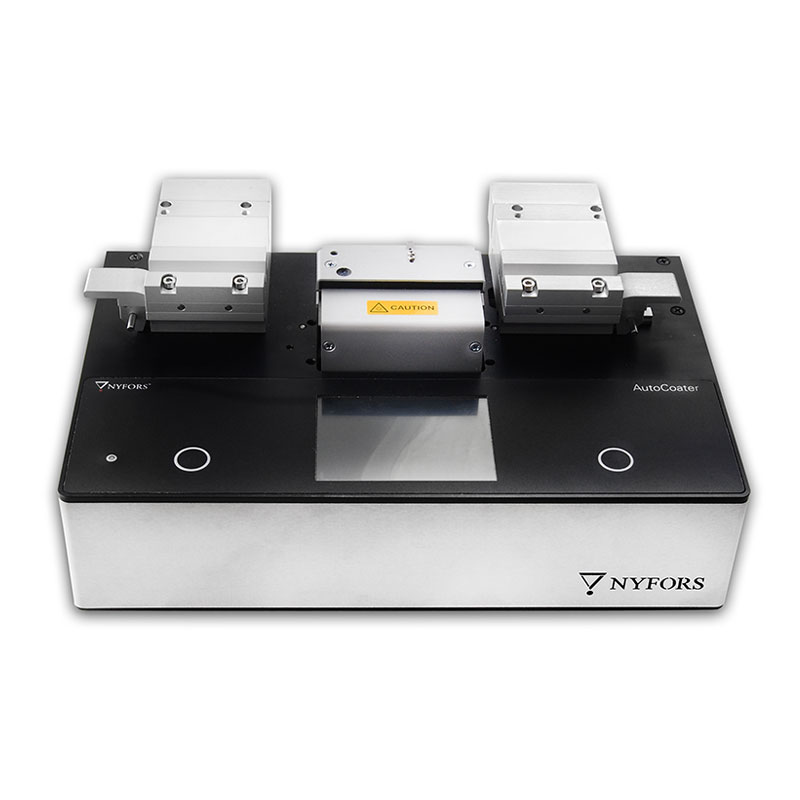
Diseñado para aplicaciones de alta resistencia, el AutoCoater 2 restaura el revestimiento protector de las fibras ópticas recubiertas de acrilato empalmadas. Es totalmente automática, lo que permite la habilidad e independencia del operario en entornos de fábrica, con una alta productividad y ventajas de costes.
a36ef45a259846fda329fed97beb9cd8
3 © 2013, AFL, all rights reserved PP-4-00067, Revision 3 , 4 14 16 Specifications are subject to change without notice Designed for high strength applications, the AutoCoater 2 restores the protective coating on spliced acrylate-coated optical fibers It is fully automatic, allowing for operator skill independence in factory environments with high productivity and cost advantages Recoating compound is injected automatically into soft silicone recoating molds identical to those used in NYFORS manual recoaters These silicone molds are easily & rapidly exchangeable with no realignment required With different sizes and custom molds available, the operator can not only easily exchange molds to meet requirements for different fiber and fiber coating diameters, but he can also choose whether to (a) recoat to a uniform diameter that exactly matches the original fiber coating diameter, (b) recoat with a cross section slightly smaller in diameter than the original fiber coating (undersize), or (c) recoat with a larger diameter that moverlaps the primary coating at each end of the recoat section (over-coating) With easy and rapid reconfiguration and simple setup, the AutoCoater 2 is the ideal choice for fully automatic skill-independent recoating operations where flexibility is required to meet many different recoating needs and specifications Rapid exchange of recoating resin type The customer selected recoating compound is automatically injected from an easily attached 1 oz Nalgene bottle, functioning as the recoater reservoir tank This greatly simplifies refilling in high volume production This bottle as well as the injection pump, supply lines, and injection needle comprise an easily exchangeable recoating compound “Dispensing Robot” The dispensing robot may be rapidly removed with only 2 screws and one electrical interface connection Since it can be removed and exchanged as a single unit, the need to purge or cleanse the injection pump and supply lines when changing from one type of recoating resin to another is completely eliminated Another option when using several compounds in parallel is to operate the recoater in manual mode, using a syringe for manual resin injection of recoating compound into the mold The combination of mold sizes and mold types (for uniform and undersize recoating as well as overcoating) and the simplicity of exchanging recoating compounds underscores the flexibility of the soft mold AutoCoater 2 as the most versatile and easily adaptable automatic recoater in the world Features • Consistent, high quality recoating • Automatic and skill independent • Short cycle time • Linear and mandrel strength testing • Uniform diameter, overcoating and undersize recoating capability • Easy exchange of recoating resin type • No need for compressed air or vacuum • Compatible with all common recoating resins including low-index and high temperature materials AutoCoater 2 ™ Dispensing Robot is easily removed from the rear of the AutoCoater for rapid recoat resin exchange Uniform Diameter Over-Mold (Over-Coating) Undersize Recoating
4 © 2013, AFL, all rights reserved PP-4-00067, Revision 3 , 4 14 16 Specifications are subject to change without notice Specifications PARAMETER VALUE Curing time Programmable, 3 s typical Cycle time 15 seconds typical Light source UV LED Wavelength 380-385 nm Injection Automatic from 1 oz bottle Mold mounting Exchangeable Mold length 34 mm and 55 mm Recoating diameter (μm) 165, 250, 300, 400, 550 and 900 μm Linear proof test Programmable, 0-22 N Mandrel Tensile Test (optional item) Programmable, 0-100 N Hold time Programmable Pull rate 0 5-20 N/s Display units lbs, kg, N, kpsi, GPa PC connection Ethernet and USB flash drive Compressed air Not needed Power supply External 12 V DC, 60 W Dimensions 270 mm (W) x 210 mm (D) x 115 mm (H) Weight 4 5 kg AutoCoater 2 ™ Other features Short curing times are achieved through an efficient UV LED array arranged along the length of the mold Curing times depend on the fiber and fiber coating diameter as well as the properties of the customer-selected recoating resin, but are typically as short as 3 seconds which allows for very fast recoating operations with total cycle times of 15 seconds or less – faster than any competing recoater on the market Besides standard High-index materials, low-index recoating compounds can be rapidly cured, typically with a curing time of no more than 30 seconds High temperature (200°C) acrylate recoating compounds useful for oil and gas down-hole applications are also compatible, as well as stiffer recoat resins suitable for recoating 900 μm jacketed fibers Strength tests can be carried out with the linear clamps or mandrels (optional) Linear proof tests can be performed up to 22 N, while the mandrels allow for tensile tests with forces up to 100 N Level of force, pulling rate and hold times at maximum force are programmable The AutoCoater 2 comes in an ergonomic, bench-top design for comfortable operation The main operator interface is a user-friendly and easy-to-navigate GUI on the touch screen control panel System software supports storable and user-defined programs for easy process change Remote monitoring and supervision can be carried out through an Ethernet interface
5 © 2013, AFL, all rights reserved PP-4-00067, Revision 3 , 4 14 16 Specifications are subject to change without notice DESCRIPTION AFL NO. Mold Options Mold, ReC 2-series, 165 μm, 34 mm (10 pieces) 10100036 Mold, ReC 2-series, 250 μm, 34 mm (10 pieces) 10100037 Mold, ReC 2-series, 300 μm, 34 mm (10 pieces) 10100038 Mold, ReC 2-series, 400 μm, 34 mm (10 pieces) 10100039 Mold, ReC 2-series, 550 μm, 34 mm (10 pieces) 10100040 Mold, Rec 2-series, 730 um, 34 mm (10 pieces) 10100078 Mold, ReC 2-series, 900 μm, 34 mm (10 pieces) 10100041 Mold, ReC 2-series, 165 μm, 55 mm (10 pieces) 10100042 Mold, ReC 2-series, 250 μm, 55 mm (10 pieces) 10100043 Mold, ReC 2-series, 300 μm, 55 mm (10 pieces) 10100044 Mold, ReC 2-series, 400 μm, 55 mm (10 pieces) 10100045 Mold, ReC 2-series, 550 μm, 55 mm (10 pieces) 10100046 Mold, Rec 2-series, 730 um, 55 mm (10 pieces) 10100079 Mold, ReC 2-series, 900 μm, 55 mm (10 pieces) 10100047 Custom molds are available upon request Miscellaneous Mold Guide Pins 10100070 Fiber Tensioner, 900 μm (left and right) 10100061 Mandrels (Rotary Tensile Test) 10100056 Dispenser Robot 10100069 Power Supply (incl US, UK and EU Adapter) 90100409 Ordering Information DESCRIPTION AFL NO. AutoCoater 2 w/ Power Supply (incl US, UK and EU Adapter), Fiber Tensioner-Standard, Packet of 250 μm Molds (34 mm length), Mold Guide Pins, Manual and Tools 10100035 Accessories AutoCoater 2 ™
Características:
- Recubrimiento consistente y de alta calidad
- Automática e independiente de la habilidad
- Tiempo de ciclo corto
- Pruebas de resistencia lineal y de mandril
- Capacidad de recubrimiento de diámetros uniformes, sobredimensionados y subdimensionados
- Fácil cambio del tipo de resina de recubrimiento
- Sin necesidad de aire comprimido o vacío
- Compatible con todas las resinas de revestimiento habituales, incluidos los materiales de bajo índice y de alta temperatura
Aplicaciones:
- Recubrimiento de la producción
Diseñado para aplicaciones de alta resistencia, el AutoCoater 2 restaura el revestimiento protector de las fibras ópticas recubiertas de acrilato empalmadas. Es totalmente automática, lo que permite la habilidad e independencia del operario en entornos de fábrica, con una alta productividad y ventajas de costes.
El compuesto de recubrimiento se inyecta automáticamente en moldes de recubrimiento de silicona blanda idénticos a los utilizados en los recubridores manuales NYFORS. Estos moldes de silicona son fácilmente & rápidamente intercambiables sin necesidad de realineación. Con diferentes tamaños y moldes personalizados disponibles, el operario no sólo puede intercambiar fácilmente los moldes para satisfacer los requisitos de diferentes diámetros de fibra y de revestimiento de fibra, sino que también puede elegir si (a) repintar con un diámetro uniforme que coincida exactamente con el diámetro de revestimiento de fibra original, (b) repintar con una sección transversal con un diámetro ligeramente inferior al del revestimiento de fibra original (subdimensionado), o (c) repintar con un diámetro mayor que se superponga al revestimiento primario en cada extremo de la sección de repintado (sobre-revestimiento).
Empalmadoras de fusión ARCMasterreg FSM100M y FSM100P+,Software de procesamiento de fibra FPS,AFL PowerCleave,CT-114, CT-115 and CT-116 Fiber Cleavers,Cuchilla de fibra CT52,Cuchilla de fibra CT58
1063