Optical fiber can be transformed to various lens shapes through today’s advanced technologies.
f84d3096c1c74060ac49f480e29a98d7
© 2015, AFL, all rights reserved. PP-4-00088, Revision 0, 7.13.15 Specifications are subject to change without notice. 116 Lensing Technologies Optical fiber can be transformed to various lens shapes through today’s advanced technologies. From medical applications to lasers, lensing is being used in hospitals, in military applications, in research and development and more. AFL produces two types of lenses. Axicon Lens An Axicon lens is used to increase the efficiency of coupling lasers and LED’s into fibers at the chip level. Produced by either polishing the tip of the fiber with a special polishing process or by using a CO2 laser to oblate the fiber end to remove the cladding material in a conical shape, an Axicon lens can be produced with either method and with similar looking results and similar performing components. The tapered Axicon is produced by heating and drawing the fiber to an abrupt tip. Although the shape of the lens is formed at a much less steep angle, the optical performance is almost exactly the same as the other two techniques. Ball Lens Ball lenses are used in the medical field for the purposes of detecting and treating cancers as well as destroying kidney stones. Ball lenses can be produced using several methods. The most common method is splicing a coreless fiber onto an existing launch fiber to form the ball at a fixed distance from the end of the launch fiber. As the beam begins to diverge into the coreless fiber, the distance and size of the ball can be constructed in such a way as to create converging, diverging or a collimated beam exiting the ball. Features • Customizable for spot size, focal length, divergence angle, etc. • High divergence angle can create diffusers • Increased coupling efficiency from devices to fibers Applications • Coupling to devices such as lasers and detectors • Optical switching • Medical applications • Sensing • Ablation Axicon Lens Ball Lens
Features:
- Customizable for spot size, focal length, divergence angle, etc.
- High divergence angle can create diffusers
- Increased coupling efficiency from devices to fibers
Applications:
- Coupling to devices such as lasers and detectors
- Optical switching
- Medical applications
- Sensing
- Ablation
Optical fiber can be transformed to various lens shapes through today’s advanced technologies. From medical applications to lasers, lensing is being used in hospitals, in military applications, in research and development and more. AFL produces two types of lenses.
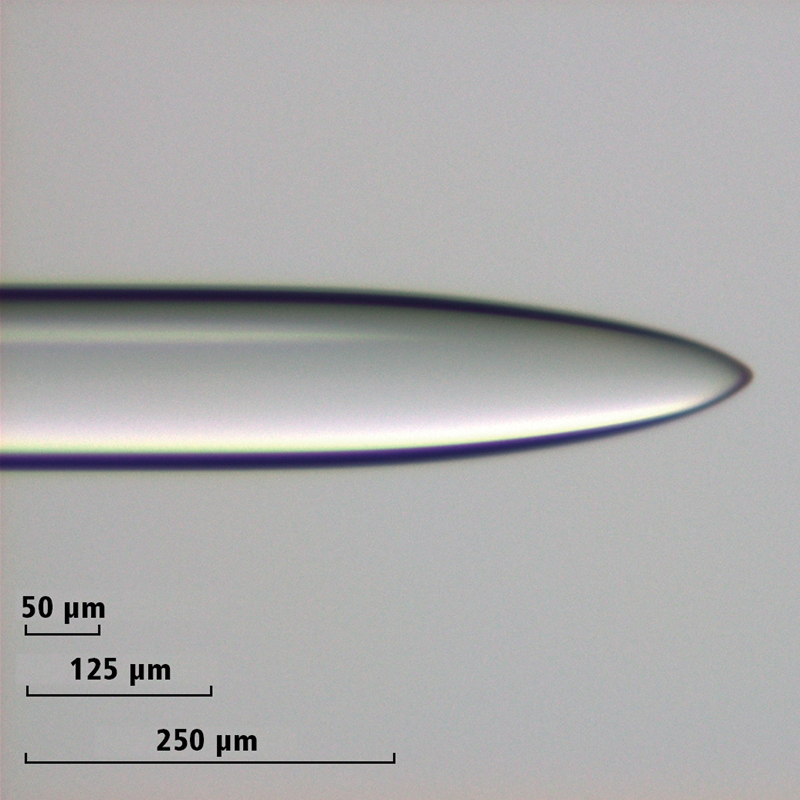
Axicon Lens
An Axicon lens is used to increase the efficiency of coupling lasers and LED’s into fibers at the chip level. Produced by either polishing the tip of the fiber with a special polishing process or by using a CO2 laser to oblate the fiber end to remove the cladding material in a conical shape, an Axicon lens can be produced with either method and with similar looking results and similar performing components.
The tapered Axicon is produced by heating and drawing the fiber to an abrupt tip. Although the shape of the lens is formed at a much less steep angle, the optical performance is almost exactly the same as the other two techniques.
Ball Lens
Ball lenses are used in the medical field for the purposes of detecting and treating cancers as well as destroying kidney stones. Ball lenses can be produced using several methods. The most common method is splicing a coreless fiber onto an existing launch fiber to form the ball at a fixed distance from the end of the launch fiber. As the beam begins to diverge into the coreless fiber, the distance and size of the ball can be constructed in such a way as to create converging, diverging or a collimated beam exiting the ball.
Fujikura 90R Fusion Splicer | AFL,Fujikura FAT-04 Ribbon Fiber Arrangement Tool | AFL,FST 12 Fiber Separation Tool | AFL,Ribbon Forming Adhesive | AFL,RT 02 Ribbonizing Tool Fusion Splicing | AFL,AFL TJ-03 Temporary Joining Tools for Fiber Optic Testing | AFL,Splice Protection Sleeves | AFL,Thermal Strippers Fusion Splicing | AFL,ASW-02 Splicing Workstation | Pole & Strand Mounting | AFL,Portable Splicing Worktray & Tripod Workstation | AFL,Splicer V-Groove Cleaning Kit for Fusion Splicers | AFL
1737